Lactate is fuel, not waste
You are halfway up a long climb on the bike. You have found a rhythm that is hard but steady. Your legs are working and your breath is deep, but nothing is getting worse. You could stay here.
Then you push a little harder to close a gap. Within minutes your legs burn, your breath runs away from you, and you have to ease off. Nothing dramatic happened. You crossed a line.
That line is your threshold. Training right at it is how you move it.
01
Lactate is made and cleared all the time.
Lactate has a bad name. It is blamed as the waste that makes your muscles burn. In fact your body makes it all the time, even sitting still, and uses it as fuel. Your muscles, heart and liver take it up and burn it, or turn it back into sugar.
In a study in California, six healthy men pedalled at four rising workloads while researchers traced lactate through their blood. At rest and at the two easier loads, the men cleared lactate almost as fast as they made it. At the two hardest loads, they made it faster than they cleared it, and it built up.
02
Threshold is where clearing stops keeping up.
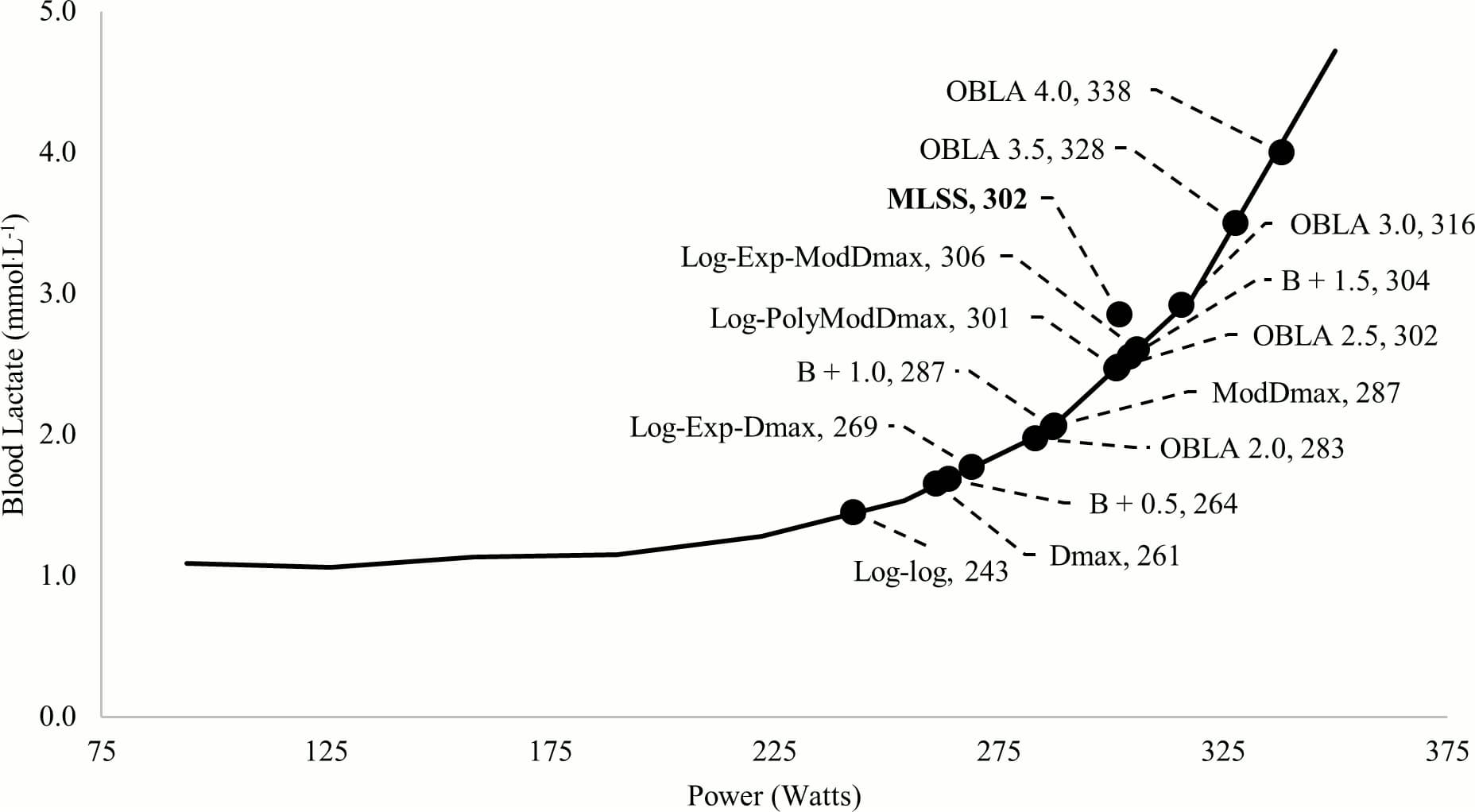
So what matters at threshold is not how much lactate you make. It is the gap between making it and clearing it. Below your threshold, your body clears lactate as fast as it makes it. Above it, lactate piles up, and sooner or later you have to ease off. Threshold is the hardest effort you can hold while clearing still keeps up.
It feels like the climb before you pushed: hard, but steady. It is an effort you feel you could keep up for about twenty minutes, and not much more.
Twenty minutes is the length of one block, not of the session. Threshold work comes in blocks of twenty minutes or less at the line, with a short, easy break between them. The breaks let you spend more time at the line than one long push would, and the whole session can last an hour.
03
The athletes who last have the higher line.
In 1988, researchers in Texas tested 14 competitive cyclists with almost the same VO₂max, the most oxygen their bodies could use. On paper they had the same engine. But in seven of them, lactate began to build up at a much harder effort than in the other seven.
Then all 14 rode at the same hard effort until they could not go on. The cyclists with the higher threshold lasted about an hour. The others lasted under half an hour. Same engine, twice the endurance.
Runners show the same thing. In a study of 18 distance runners, the pace at which lactate began to build up predicted their race times better than anything else measured, at every distance up to the marathon.
04
Your muscles and your heart burn it.
Follow one piece of lactate on that climb. It is made inside a fibre in your thigh that is working hard. To be used, it has to leave. It goes out through small doors in the fibre's wall, proteins called transporters. Their names are MCT1 and MCT4.
Once out, it has places to go. A quieter fibre next door can take it in and burn it. So can your heart. In San Francisco, researchers studied nine trained men as they rode. A fine tube in the vein that drains the heart showed what the heart was taking in. Within five minutes of starting, the heart was taking in more than three times as much lactate as at rest. It burned all of it. Lactate was one of the fuels keeping the heart beating.
Training builds more doors. In Berkeley, men rode a bike for nine weeks. Afterwards, their thigh muscle had 90 percent more of the MCT1 transporter. Some of the new transporters sat in the walls of the mitochondria, so a fibre could feed lactate straight into its own power plants.
In nine men who trained the same way, lactate in the blood at the same workload was 41 percent lower afterwards. Their legs made less of it. And at hard efforts, their legs and the rest of their bodies cleared more of it.
That is the line moving, from the inside. The same climb makes less lactate, and more of what it makes is burned on the way.
05
Training at the line moves the line.
In Sweden, eight well-trained runners added one run a week to their usual training, on a treadmill at the pace where their lactate began to build up. After 14 weeks, the pace at that line had risen. Their VO₂max had not changed. The line moved; the engine stayed the same.
This is you getting better at exactly what you train. The American coach Jack Daniels, whose threshold teaching this chapter follows, makes it the whole purpose of threshold work in Daniels' Running Formula: to improve your body's ability to clear lactate. The effort you can sustain rises, and every effort below it costs you less.
06
Too fast trains a different workout.
You are swimming out to the far buoy with a strong, long stroke you could keep all the way. Then you kick on to pass someone. A few minutes later your stroke is short, your breathing is ragged, and you are clinging on.
The Swedish study saw this too. The more the runners' lactate was still rising late in their weekly runs, the less their line moved. They had been running above it. Once lactate piles up, you are no longer training your body to clear it. You are doing a different, harder workout that costs far more to recover from.
07
Too slow never pushes the line.
You are running a flat trail with a friend, talking the whole way. Your body clears lactate with room to spare. That run has its own value, but it never pushes your body to clear lactate as fast as it can, so the line does not move.
The effort that moves it is narrow. Right at the line, where your body has to clear lactate flat out just to keep up.
08
The benefit comes from holding it.
A few minutes at threshold is a glimpse of it. The change comes from staying there, steady, for as long as you truly can. That is what a threshold run, ride or swim is built around.
The limit is set by control, not by grit. The movement stays smooth and even. When you start gritting your teeth to hang on, you have crossed the line, and the work has changed. To learn where that line sits, heart rate can teach you.
Think of the climb again. Every minute you hold just under that line hands your muscles and your heart more lactate to burn, and your muscles build more doors to let it through. One day you will ride the same climb at the same speed, and it will feel like the rhythm before you pushed. Hard, steady, nothing getting worse. The line will have moved above you, and you will be able to stay.
Sources
- Jamnick et al. 2018. PLOS ONE 13:e0199794. An examination and critique of current methods to determine exercise intensity thresholds.
- Brooks 2018. Cell Metabolism 27:757-785. The science and translation of lactate shuttle theory.
- Stanley et al. 1985. American Journal of Physiology 249:E595-E602. Systemic lactate kinetics during graded exercise in man.
- Coyle et al. 1988. Journal of Applied Physiology 64:2622-2630. Determinants of endurance in well-trained cyclists.
- Farrell et al. 1979, reprinted 1993. Medicine and Science in Sports and Exercise 25:1091-1097. Plasma lactate accumulation and distance running performance.
- Gertz et al. 1988. Journal of Clinical Investigation 82:2017-2025. Myocardial substrate utilization during exercise in humans.
- Dubouchaud et al. 2000. American Journal of Physiology, Endocrinology and Metabolism 278:E571-E579. Endurance training, expression, and physiology of LDH, MCT1, and MCT4 in human skeletal muscle.
- Bergman et al. 1999. Journal of Applied Physiology 87:1684-1696. Active muscle and whole body lactate kinetics after endurance training in men.
- Sjödin, Jacobs and Svedenhag 1982. European Journal of Applied Physiology 49:45-57. Changes in onset of blood lactate accumulation after training at that intensity.
- Daniels 2014. Daniels' Running Formula, 3rd edition. Human Kinetics. Threshold training.