Your head belongs on top of your body
Sit on the edge of a chair and slump. Let your back round and your head slide forward, the way it does over a phone. Now lift both arms out to the sides and up as high as they go. Notice where they stop.
Now sit tall and bring your head back until your ears are over your shoulders. Lift your arms again. They go higher, and they feel lighter on the way up. Your shoulders did not change in ten seconds. Your line did.
01
The line runs from your ankles to your head.
Look at a strong body from the side and you can draw one straight line through it. It runs up from the ankle, through the knee, the hip and the shoulder, to the ear. Each part sits on top of the part below it. That is the line. On the line, you are strong. Off it, you lose power, structure, balance and range.
The head sits at the top of the line, and it is heavy. Your head and your back work as one chain: when one moves, the other follows. In an Australian study, slumped sitting carried the head forward and down. The chain works from the top down too. Push your head forward now and feel your upper back start to round.
Daily life pulls the head off the line. In a study in Korea, people using a phone bent their heads 33 to 45 degrees forward of upright. Add the desk, the car and the sofa, and most of a day is spent in a chair. Hour by hour, the head learns to live in front of the body.
This is not about pain. A forward head has not been shown to cause pain on its own. The cost is in what your body can do.

02
Off the line, you are weaker.
Researchers sat 34 healthy adults slumped and then upright, and tested their shoulders both ways. In the slump, the whole upper back rounded, and the head goes with it, as you felt.
Slumped, their arms rose almost 24 degrees less. Then each person held an arm out level, just forward of their side, and pushed up against a gauge. Slumped, they pushed 16 percent less hard. Same people, same day, only the posture changed.
03
On the trail, the bike and in the water.
Picture the last steep descent of a long trail run. You are tired, so you start watching your feet. Your head drops, your back rounds, and your feet begin to slap and catch. Now drop only your eyes. Keep your head on the line and look down the trail. Your hips stay under you and your feet land where you meant them to.
Going up, lean from your ankles, not your waist. The whole line tilts forward together, head included, and your eyes look up the trail. Let your head drift forward instead and you breathe worse: when 15 men sat with their heads forward, their lungs moved less air.
On the bike, the top of the line comes with you: hip, shoulder and ear, tilted forward together. You lean forward from the hips, and your head stays in line with your back. An hour into a headwind, the chin pokes out and the shoulders creep up towards the ears. Your neck tires and the whole ride feels harder. Slide your chin back and lift your eyes, not your face, to see the road. Comfort on the bike starts there.
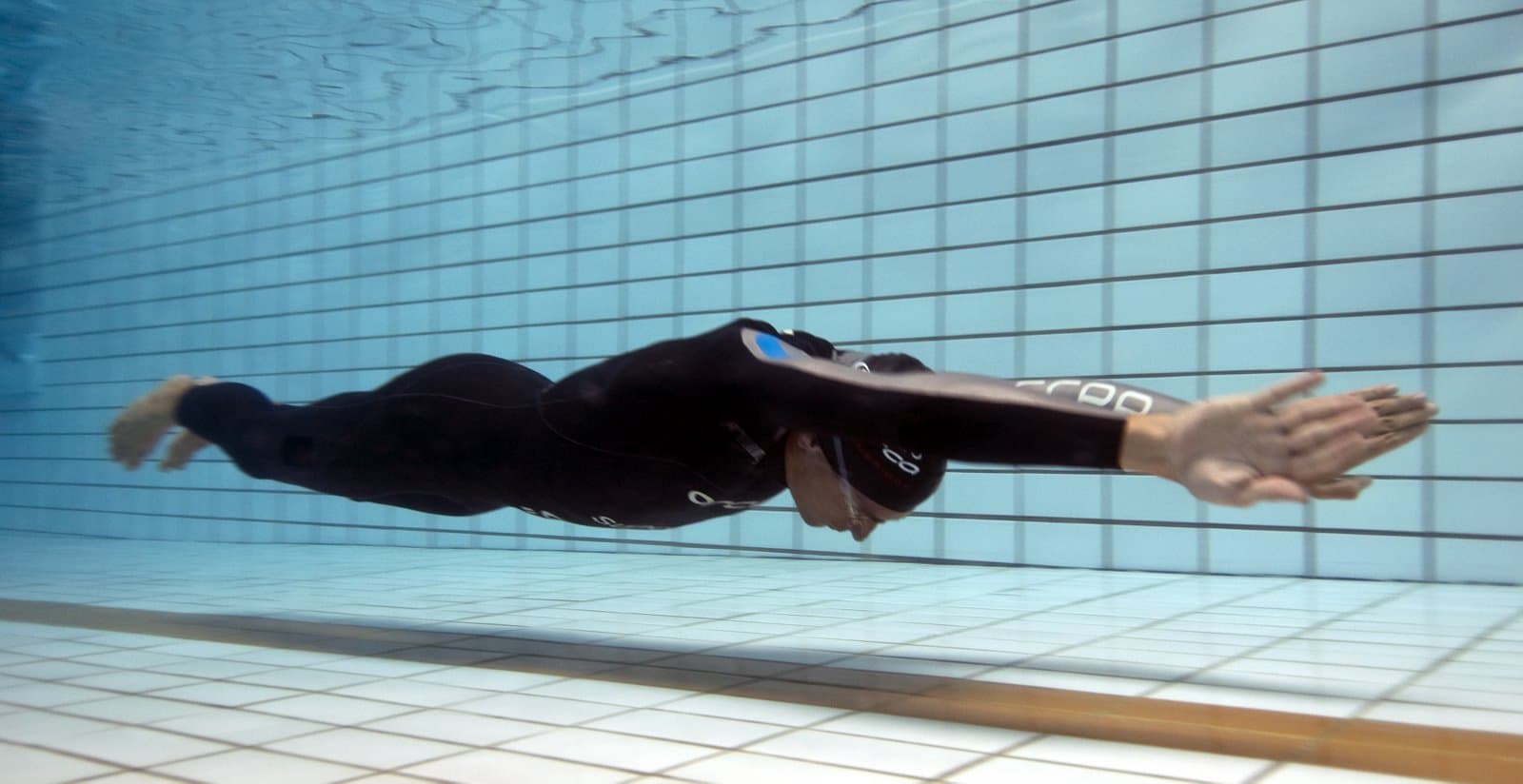
In the water, the line lies down. Italian researchers towed ten swimmers underwater in a glide, arms overhead. Keeping the head in line cut the drag by about 11 percent compared with lifting it. And when you lift your head, your hips sink.
04
It will not fix itself.
A head that has lived forward for years does not come back because you read about it. Your brain has learned where the head goes, and puts the head back there the moment you stop paying attention. The line has to be practised until it is the one your brain chooses.
It can be trained. A review of 28 trials, in people whose posture had drifted, found that exercise brings the head back toward the line.
05
How your training builds it.
Yoga starts and ends every salutation in mountain pose. You stand tall, the crown of your head reaching up, ribs over hips. It is the line, practised on purpose. In the hollow hold, you lie on your back, press your low back flat into the floor, draw your knees up over your hips, tuck your chin and lift your head and shoulders, holding the front of your body, neck to hips, as one piece. Tucking the chin makes the deep muscles at the front of your neck work, the ones that keep your head on the line.
Kettlebells test the line under load. In the overhead carry, you walk with a bell locked out above you, eyes forward, and the line stands straight up beneath it. The loaded walk is ten to 20 minutes with one bell at your side, and the only rule is to stay tall the whole way.
Swimming drills keep one rule: never lift your head to breathe. Roll with your body instead, and let your head rest.
What this means for you
Find your line once. Ask someone to take a photo of you from the side, standing the way you normally stand. Look for your ear over your shoulder and your shoulder over your hip.
Then reset it at the same moments every day: when you sit down at your desk, get in the car or pick up your phone. Crown of the head up. Chin slides back, not down. Ears over shoulders, eyes level. Rest your tongue on the roof of your mouth to keep your jaw and neck quiet, and breathe through your nose. It takes two seconds.
On a run or a ride, do the head part of the reset at the top of every climb and whenever you feel tired: crown up, chin back, eyes level. Let your breathing be whatever the effort asks. Making the line stick takes weeks of repeats, not days.
Every reset teaches your brain where your head belongs. Keep it there, and you will feel it in everything you do.
Sources
- Kebaetse, McClure and Pratt 1999. Archives of Physical Medicine and Rehabilitation 80:945-950. Thoracic position effect on shoulder range of motion, strength, and three-dimensional scapular kinematics.
- Caneiro et al. 2010. Manual Therapy 15:54-60. The influence of different sitting postures on head/neck posture and muscle activity.
- Lee, Kang and Shin 2015. Ergonomics 58:220-226. Head flexion angle while using a smartphone.
- Moustafa, Kim and Harrison 2023. Journal of Sport Rehabilitation 32:53-62. Comparison of sensorimotor integration and skill-related physical fitness components between college athletes with and without forward head posture.
- Jantoon and Uthaikhup 2021. Thai Journal of Physical Therapy 43:22-30. Forward head posture does not affect sensorimotor function in healthy university students.
- Koseki, Kakizaki, Hayashi, Nishida and Itoh 2019. Journal of Physical Therapy Science 31:63-68. Effect of forward head posture on thoracic shape and respiratory function.
- Cortesi and Gatta 2015. Journal of Human Kinetics 49:37-45. Effect of the swimmer's head position on passive drag.
- Khorramroo, Rostami and Bafrouei 2026. BMC Sports Science, Medicine and Rehabilitation 18:302. Corrective exercises strongly improve posture but fail to produce consistent clinical or functional benefits in patients with upper crossed syndrome, a systematic review and meta-analysis.