Speed is trained in the nerves, not the lungs
The group ride is nearly home, and the road kicks up towards the village sign. Someone goes early. You have ridden for three hours and your legs feel fine. But when you stand on the pedals, the bike does not jump forward, and you watch the gap grow.
Your engine was not the problem. You had simply never practised riding fast.
01
Speed is power, tuned to your sport.
Power is making force quickly, with the whole body firing at once. A kettlebell swing builds it. That is raw horsepower, and it belongs to no sport in particular.
Speed is that horsepower put to work in one movement: your stride, your pedal stroke, your pull through the water. Each of them fires its muscles in its own order and rhythm. An all-out effort in that movement trains you to fire every muscle it needs, together, in the right order and at full speed.
So speed work is short, all-out efforts in your own sport. Each one is over in seconds. Your heart and lungs are barely taxed, because the work happens in your nerves and muscles.
02
Speed is trained in your nervous system.
Every muscle is switched on by nerves. One nerve and the muscle fibres it drives work as a single unit. To move faster, your brain has to switch on more of those units, sooner, and fire them faster. That is a skill, and it is learned by doing it.
In Brussels, five people trained one small movement for twelve weeks: lifting the foot at the ankle as fast as they could, against a light load. The movement got faster. Yet the muscle itself had not changed. Made to twitch by an electrical pulse, it contracted exactly as before.
What had changed was the signal. The units switched on earlier and fired faster. And far more of them fired in rapid double bursts that make a muscle snap on: 33 percent of the units, against 5 percent before.
03
Base work barely wakes the fastest fibres.
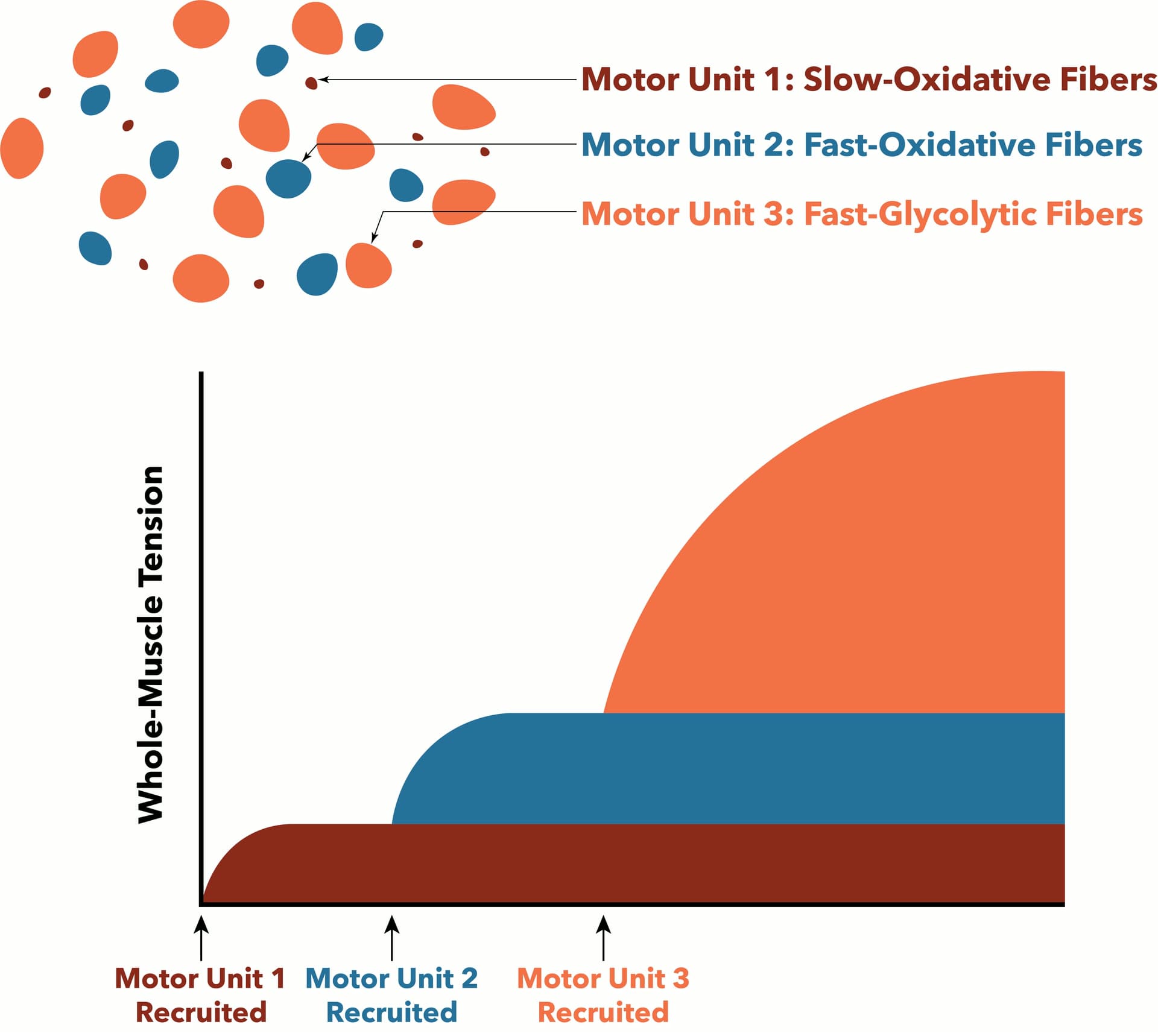
Your muscles hold two kinds of fibre. Slow fibres are built to burn fuel with oxygen, and they keep going. Fast fibres contract faster and harder. Your nervous system does not switch them all on at once. It calls on them in order, slow first, and fast only when it needs more.
In 1974, the physiologists Philip Gollnick, Karin Piehl and Bengt Saltin had volunteers ride at efforts from very gentle to harder than their VO₂max. Then they looked at thin slices of thigh muscle to see which fibres had used up their stored sugar, because a fibre that worked is a fibre that emptied.
Below VO₂max, the slow fibres always emptied first. The fast ones joined in only as the ride went on and the slow ones ran low. After three hours of gentle riding, plenty of sugar was still left in the muscle, almost all of it in the fast fibres. They had barely been used. Spinning the pedals faster did not change the pattern. Only the effort did. Above VO₂max, both kinds emptied from the very start.
So a long, steady ride trains the slow fibres for hours and leaves the fastest ones mostly asleep. An all-out sprint is the moment your nerves switch on everything, fast fibres included, at full speed and in the right order. That is the only time you practise it.
Trained endurance athletes can learn this in weeks. At a university in Utah, 17 trained cyclists kept up their usual riding, and ten of them added all-out sprints on the bike for four weeks. That was under half an hour of sprinting in the whole month. Afterwards, their main thigh muscle showed more electrical activity during a sprint. Their nerves were switching on more of it.
04
Every sport has its own speed.
Horsepower does not turn into speed by itself. In New Jersey, 25 young male athletes trained for seven weeks. One group lifted weights, one sprinted, and one did both. All three added about the same weight to their squat.
But only the group that lifted and sprinted ran a clearly faster 30 metres. Lifting gave them more to work with. Sprinting taught them to use it in a stride.
That is why speed belongs to each sport on its own terms. A hill sprint trains you to drive off the ground, and loads your calves and tendons hard. A sprint on the bike trains you to spin fast against resistance, and does nothing for how your foot meets the ground. A sprint in the water fires your whole body at once, long and strong through the catch, with no impact anywhere.
05
Seconds of speed make the long hours cheaper.
Speed sounds like a sprinter's concern. It is not. In New Zealand, 20 well-trained distance runners added hill reps to their training for six weeks, at five different intensities.
The group whose reps were the shortest and fastest, only seconds each, improved their running economy the most, by 2.4 percent. Running economy is how much energy it costs you to hold a given pace. That group also gained the most in every test of how their muscles and nerves performed.
A stride that costs less is cheaper for every hour of a long day out. The seconds of speed paid for themselves in the hours.
06
Speed is not a hard interval.
Hard intervals and speed look alike from a distance. Both are fast. But an interval lasts minutes and leaves you gasping, because its job is your heart and lungs. A sprint is over before your breathing catches up. Its job is your nervous system.
So speed follows different rules. Every effort is all-out, and you rest until you feel fresh, however long that takes. A sprint started tired is slower, and slow sprints make you slower. When you feel yourself slowing, the work is done. Finishing out of breath means the sprints turned into intervals.
07
You can feel it getting faster.
Progress in speed is easy to notice, because it is a skill. On the trail, your stride gets lighter and quicker without you trying. In the water, a fast length feels long and smooth instead of thrashing. Hands loose, nothing straining, more of you working at once.
None of this needed a bigger engine. The heart, the lungs and the hours stayed what they were. What changed was the signal: more fibres switched on, sooner, in the right order. So the next time the road kicks up towards the village sign and someone goes early, you stand on the pedals, and the bike jumps forward.
Sources
- Van Cutsem, Duchateau and Hainaut 1998. Journal of Physiology 513:295-305. Changes in single motor unit behaviour contribute to the increase in contraction speed after dynamic training in humans.
- Gollnick, Piehl and Saltin 1974. Journal of Physiology 241:45-57. Selective glycogen depletion pattern in human muscle fibres after exercise of varying intensity and at varying pedalling rates.
- Creer et al. 2004. International Journal of Sports Medicine 25:92-98. Neural, metabolic, and performance adaptations to four weeks of high intensity sprint-interval training in trained cyclists.
- Ross et al. 2009. Journal of Strength and Conditioning Research 23:385-394. The effects of treadmill sprint training and resistance training on maximal running velocity and power.
- Barnes et al. 2013. International Journal of Sports Physiology and Performance 8:639-647. Effects of different uphill interval-training programs on running economy and performance.