How hard intervals grow your heart
You are on a long climb, and the rider ahead lifts the pace. You go with them. Your breathing is as big as it gets, and your heart is pounding in your ears. For a minute, maybe two, you hold the wheel.
Then you cannot. Your legs still turn, but the gap opens. You did not run out of will. You ran out of oxygen.
01
VO₂max is the top of your engine.
Every stroke, stride and pedal turn runs on oxygen. You breathe it in, your blood picks it up in your lungs, your heart pumps it out, and your muscles burn it to move.
There is a limit to how much of that can happen in a minute. That limit is your VO₂max, the most oxygen your body can take in and use. On the climb, you had reached it.
02
The heart sets the limit.
Your lungs can usually pull in more air than your blood can carry away. Your muscles can usually burn more oxygen than reaches them. The narrow point sits in between, at the pump.
When two American physiologists reviewed what limits VO₂max, they found it was the delivery of oxygen to the muscles. And when training raised VO₂max, it did so mainly because the heart could pump more blood at its hardest.
Your heart can only beat so fast. So the way to pump more is to push out more blood with every beat.
03
A bigger beat starts with a heart that fills.
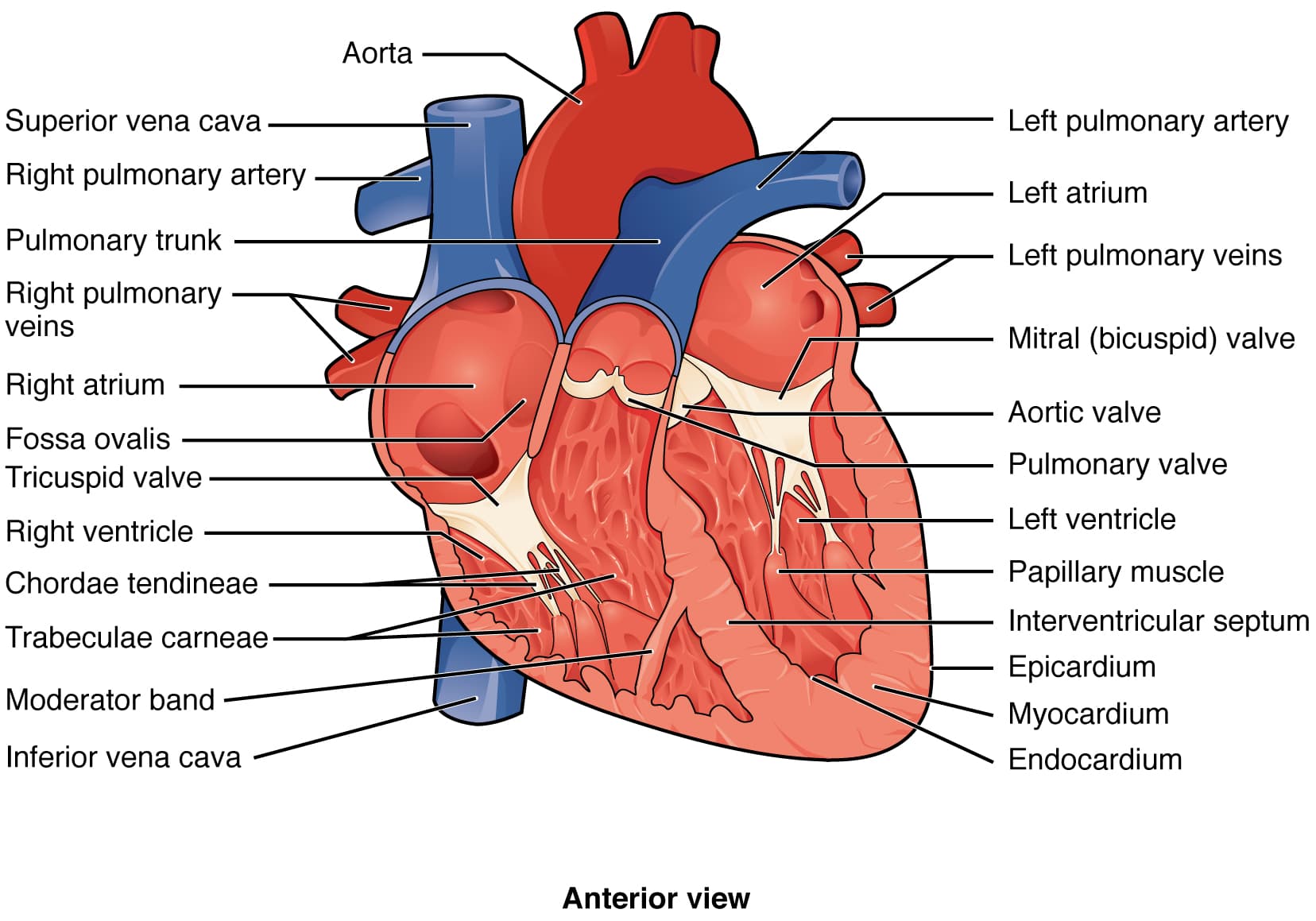
Each heartbeat has two halves. First the left ventricle, the heart's main pumping chamber, relaxes and fills with blood. Then it squeezes and sends that blood out to the body. What it can send out depends on how much it held.
When the heart researcher Benjamin Levine looked at why the best endurance athletes reach such a high VO₂max, the answer was in that filling. Their left ventricle is large and stretchy. It relaxes quickly between beats, and it fills with a big volume of blood every time.
More blood helps it fill. In Copenhagen, nine untrained volunteers rode a bike for six weeks at a steady effort. Afterwards, their blood volume had risen by 7 percent, about 380 millilitres, a little more than a can of drink. The most blood their hearts could pump in a minute rose by 9 percent, and their VO₂max by 10. Scans of their hearts showed no change in shape yet. In those first weeks, the gain came with more blood, not a bigger heart.
04
Hard intervals made the heart pump more.
In Norway, 40 moderately trained men trained for eight weeks. One group ran long and slow, one ran at threshold, and two ran hard intervals. Every group did the same total amount of work.
Only the interval groups raised their VO₂max, by 5.5 and 7.2 percent. Their hearts also pushed out about a tenth more blood with each beat. The researchers saw the two move together: the bigger the beat, the higher the ceiling.
The same work, done at the top, made a stronger pump.
05
The top is too hard to hold in one go.
At your VO₂max, you are breathing as hard as you can and your whole body is working. It is an effort you can keep for a few minutes. If it feels like you could last only thirty seconds, you are going too fast.
So you split it up. You go to the top, stay there as long as you truly can, then ease off and recover. Then you go again.
In France, eight long-distance runners tried both ways. Once they ran one hard, continuous run until they could not go on. Once they ran short bursts at the speed of their VO₂max, each followed by a short stretch of easy running.
In the continuous run, they spent about 2 minutes and 40 seconds at their VO₂max. With the breaks, they spent nearly 8 minutes there. The breaks nearly tripled the time at the top.
06
The recovery is part of the work.
This is the same idea as power. You give yourself time to recover from a maximal effort, so the next one can be maximal too.
What you train is the time spent at the top. One long effort spends it all at once and stops. Intervals let you come back for more, and that is how you pile it up.
07
It is rare, and it pays.
This is the hardest work in endurance training. It takes more out of you than anything else you do, so it does not come often.
But it is very efficient. A higher ceiling lifts everything under it. The base pace, the steady climb and the long swim all become a smaller share of what your body can do. So each of them costs less.
08
It stands on the base.
A big pump needs somewhere to send the blood. The tiny vessels that run between your muscle fibres, the capillaries, are where the oxygen leaves the blood. They grow from long, steady hours.
The heart grows slowly too. In Dallas, 12 people who had not trained spent a year building up to a marathon. For the first six to nine months, the walls of the left ventricle grew thicker. Only after that did the chamber itself grow larger, with room for more blood. Their VO₂max rose by about a fifth. After a full year, their hearts were as big as those of elite endurance athletes. They still could not fill and pump as well as the athletes' hearts did.
That is the order inside you. Months of training bring the extra blood and the bigger chamber, and the long hours build the streets to deliver it. The hard minutes at the top then push that heart to its biggest beat. A VO₂max swim, ride or run on a body with that base sharpens a big engine. On a body without it, there is little to sharpen.
Sources (6)
- Bassett and Howley 2000. Medicine and Science in Sports and Exercise 32:70-84. Limiting factors for maximum oxygen uptake and determinants of endurance performance.
- Levine 2008. Journal of Physiology 586:25-34. VO2max: what do we know, and what do we still need to know?
- Bonne et al. 2014. American Journal of Physiology, Regulatory, Integrative and Comparative Physiology 306:R752-R760. Phlebotomy eliminates the maximal cardiac output response to six weeks of exercise training.
- Helgerud et al. 2007. Medicine and Science in Sports and Exercise 39:665-671. Aerobic high-intensity intervals improve VO2max more than moderate training.
- Billat et al. 2000. European Journal of Applied Physiology 81:188-196. Intermittent runs at the velocity associated with maximal oxygen uptake enable subjects to remain at maximal oxygen uptake for a longer time than intense but submaximal runs.
- Arbab-Zadeh et al. 2014. Circulation 130:2152-2161. Cardiac remodeling in response to 1 year of intensive endurance training.