The body moves together
Take one step up a steep path. Your foot finds the rock and grips it. Your ankle bends, your knee and hip straighten and your trunk stays firm so the push does not leak away. The opposite arm swings forward to balance the leg, and your head stays level so your eyes can find the next step.
One step, and almost every part of you took part in it.
01
The body is a chain.
Force travels through the body the way it travels through a chain. It starts where you touch the world, at the foot on the rock or the hand on the water, and passes from joint to joint until it moves you. Coaches call this the kinetic chain: a series of links that only work together.
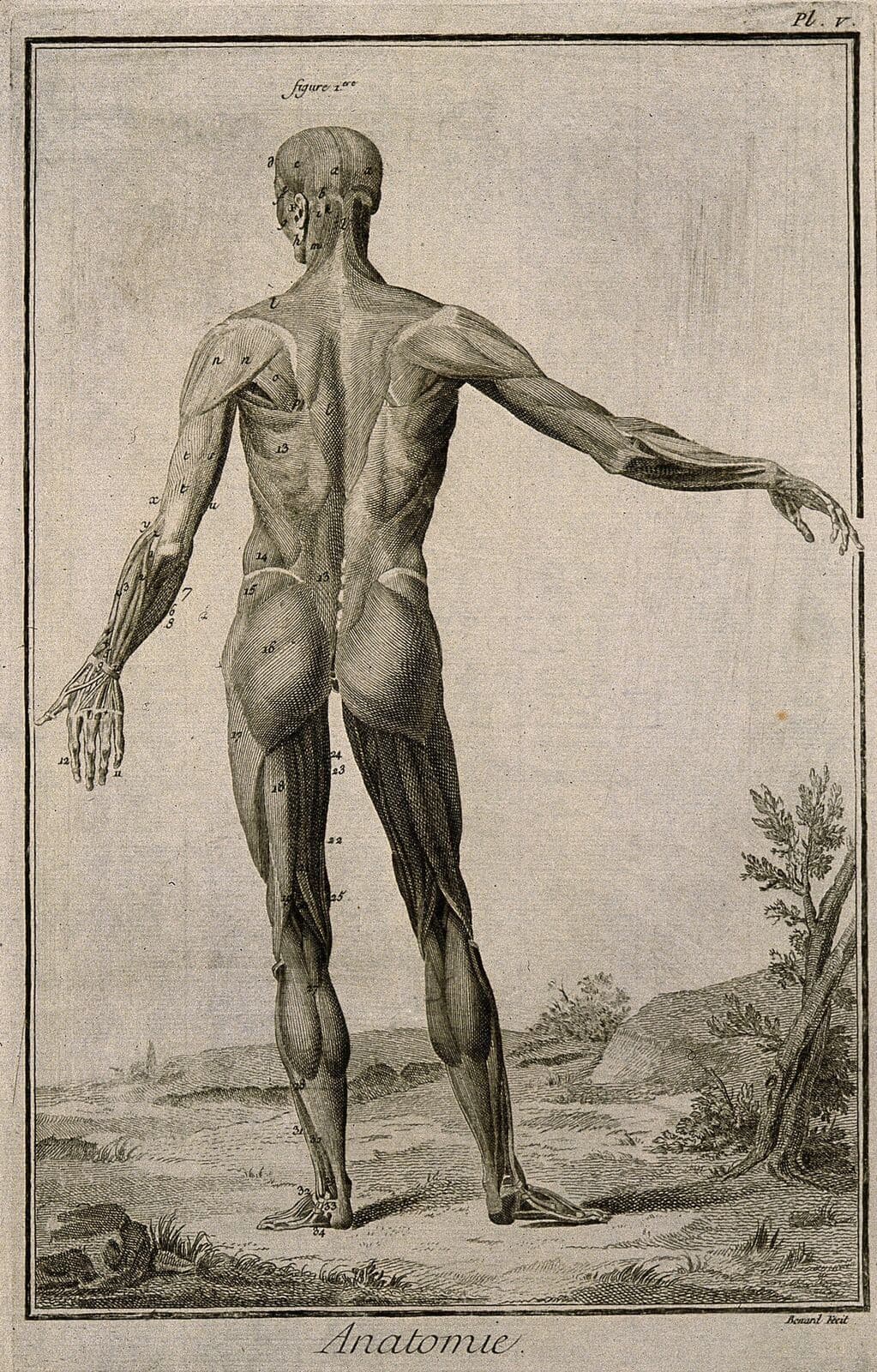
The links are joined in more than one way. Muscles do not simply end at a bone. They are wrapped in connective tissue, called fascia, that runs on into the next muscle along. A review of dissection and laboratory studies found moderate evidence that pulling on one muscle passes tension into its neighbour, along the back of the body from the calf to the hamstrings to the lower back. The evidence is still young. But the picture fits what you feel: nothing in the body works alone.
02
A chain fails at its weakest link.
A chain is only as strong as its weakest link, and the body is the same. Your step up the rock is limited by whichever part gives first. If the ankle cannot bend, the hip has to make up for it. If the trunk is soft, the push from the legs leaks away before it moves you.
That is why making one link stronger, on its own, changes so little. Make one muscle stronger, and the movement barely changes if the muscles around it cannot use the strength.
03
Tight hamstrings are rarely just the hamstrings.
Take the most common complaint of all: tight hamstrings, the muscles at the back of the thigh. Most people who have them stretch them, often for years, and many find they are as tight as ever. That is because the hamstrings are one link in a long chain. They hang from the pelvis, so how your pelvis tilts sets how far they can lengthen. Below them sit the calves, and above them the back and the neck.
Researchers have watched that chain at work. When physiotherapists in Australia raised people's straight legs, simply pulling the foot up towards the shin cut how far the leg would go by nine degrees. The hamstrings had not changed. The ankle had. In Spain, 70 young adults with short hamstrings had a gentle hands-on release at the back of the neck, and their hamstrings lengthened, while a group given a sham treatment saw no change. And in Germany, people who stretched their calves and hamstrings could then move their necks further than before. That last study had only 26 people, but all three point the same way.
So tight hamstrings are often a symptom, not the problem. The pelvis, the calves, the inner and outer thighs, the back and even where you hold your head all play a part. Stretch one muscle while the rest stays as it is, and the chain pulls it back.
04
Strength that stays in the machine.
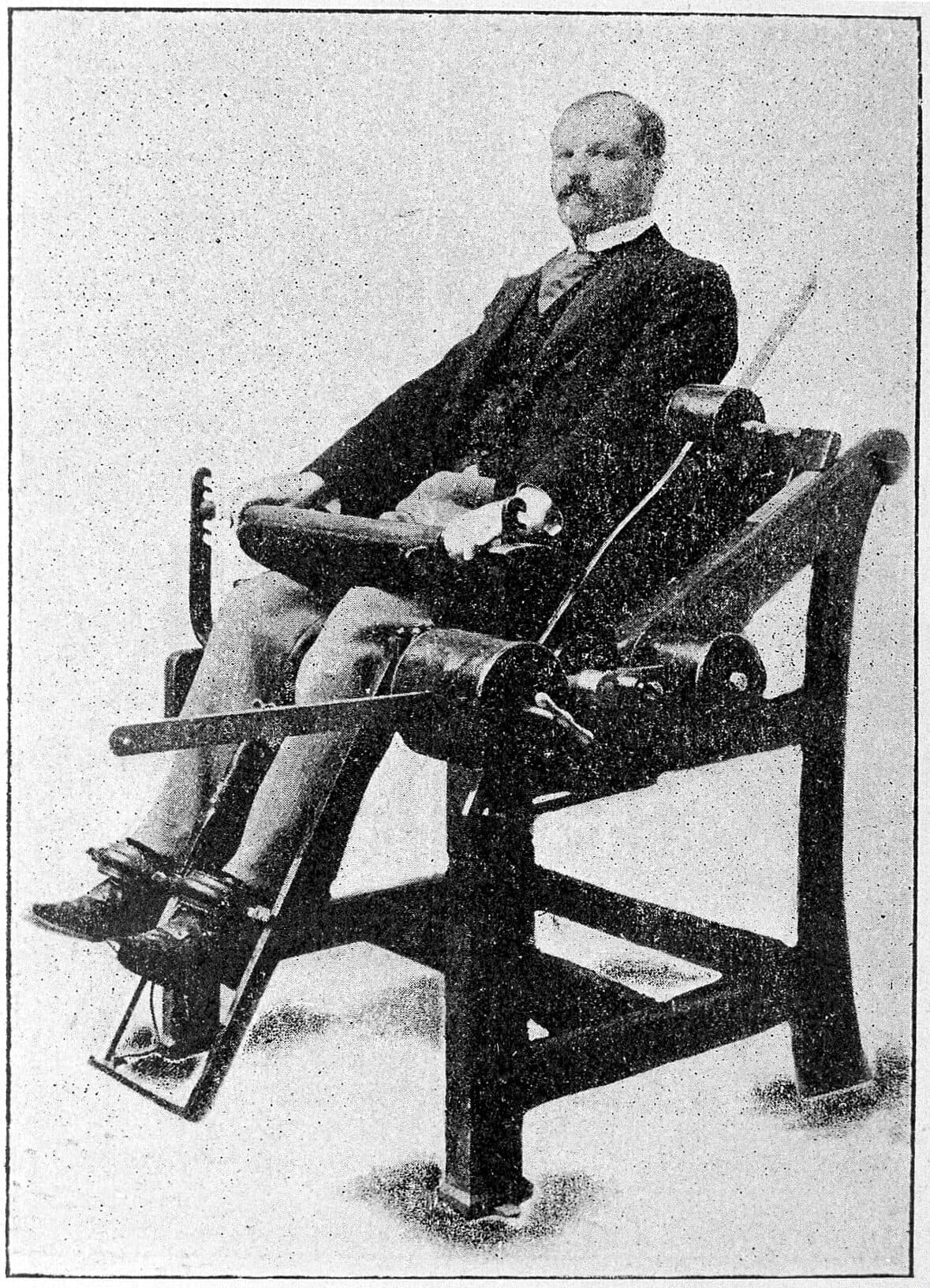
Researchers in London saw this clearly. Young adults trained their thighs on a leg-extension machine for 12 weeks. The weights they lifted rose by about 200 percent. But when the researchers measured the thigh's actual strength, it had grown by only 15 to 20 percent. Most of the gain was the body learning to coordinate the other muscles in the lift, the ones that held the rest of the body steady. The strength belonged to that one movement.
A study in Sweden then compared two ways of training the same muscles. For six weeks, one group did barbell squats and the other used leg machines that move one joint at a time. Both got stronger. But the squat group jumped 10 percent higher afterwards, and the machine group did not jump any higher at all. Training the whole chain changed how they moved. Training the parts did not.
05
Whole movements build more.
The same holds when the amount of work is equal. In Italy, two groups of active men lifted exactly the same total load for eight weeks. One group used whole-body lifts, the other only single-joint exercises. The whole-body group gained more strength on every test, even on the single-joint machine the other group had trained on. Their aerobic fitness rose by 12.5 percent, against 5.1 percent for the others.
So we train movements, not muscles. Squat, push, pull, carry, climb, swim and run, and every link learns to work with the others.
06
Where single muscles still belong.
There is one honest place for training a single muscle: recovering from an injury. When a physiotherapist finds a weak or damaged link, targeted exercises bring it back. That is rehabilitation, and it works best with someone who can see the problem. Once the link is back, it rejoins the chain.
07
The links, one at a time.
The chapters that follow look at the links you can feel most. Strong feet, where every movement meets the ground. The core is where every push and pull braces. Then the head, which steers the body, and the hands, which organise it. Each one changes what the rest can do. This is the body that mobility, strength and endurance build together.
What this means for you
The next time you train, choose movements that use the whole body: lifting from the floor, stepping up, carrying, pushing and pulling while you stand. Keep single-muscle exercises for when a physiotherapist gives you them.
The body is a chain, and it moves only as well as its weakest link. Strengthen or loosen one muscle while everything around it stays the same, and you will barely move any better. Train the chain.
Sources
- Krause, Wilke, Vogt and Banzer 2016. Journal of Anatomy 228:910-918. Intermuscular force transmission along myofascial chains, a systematic review.
- Boland and Adams 2000. Australian Journal of Physiotherapy 46:191-200. Effects of ankle dorsiflexion on range and reliability of straight leg raising.
- Aparicio et al. 2009. Journal of Manipulative and Physiological Therapeutics 32:262-269. Immediate effects of the suboccipital muscle inhibition technique in subjects with short hamstring syndrome.
- Wilke, Niederer, Vogt and Banzer 2016. Journal of Sports Sciences 34:2145-2148. Remote effects of lower limb stretching, preliminary evidence for myofascial connectivity?
- Rutherford and Jones 1986. European Journal of Applied Physiology 55:100-105. The role of learning and coordination in strength training.
- Augustsson et al. 1998. Journal of Orthopaedic and Sports Physical Therapy 27:3-8. Weight training of the thigh muscles using closed vs. open kinetic chain exercises.
- Paoli et al. 2017. Frontiers in Physiology 8:1105. Resistance training with single vs. multi-joint exercises at equal total load volume.