Relax your hands and your whole body follows
Squeeze one hand into a fist, as hard as you can, and hold it. Your forearm goes hard. Then your upper arm, then your shoulder. Your jaw tightens and your breath stops.
Now open the hand and let it hang. Your shoulder drops, and your breath comes back.
You only squeezed your hand, and your shoulder and jaw tightened with it. Whatever your hands do, the rest of your body does too.
01
Your hands are wired into everything.
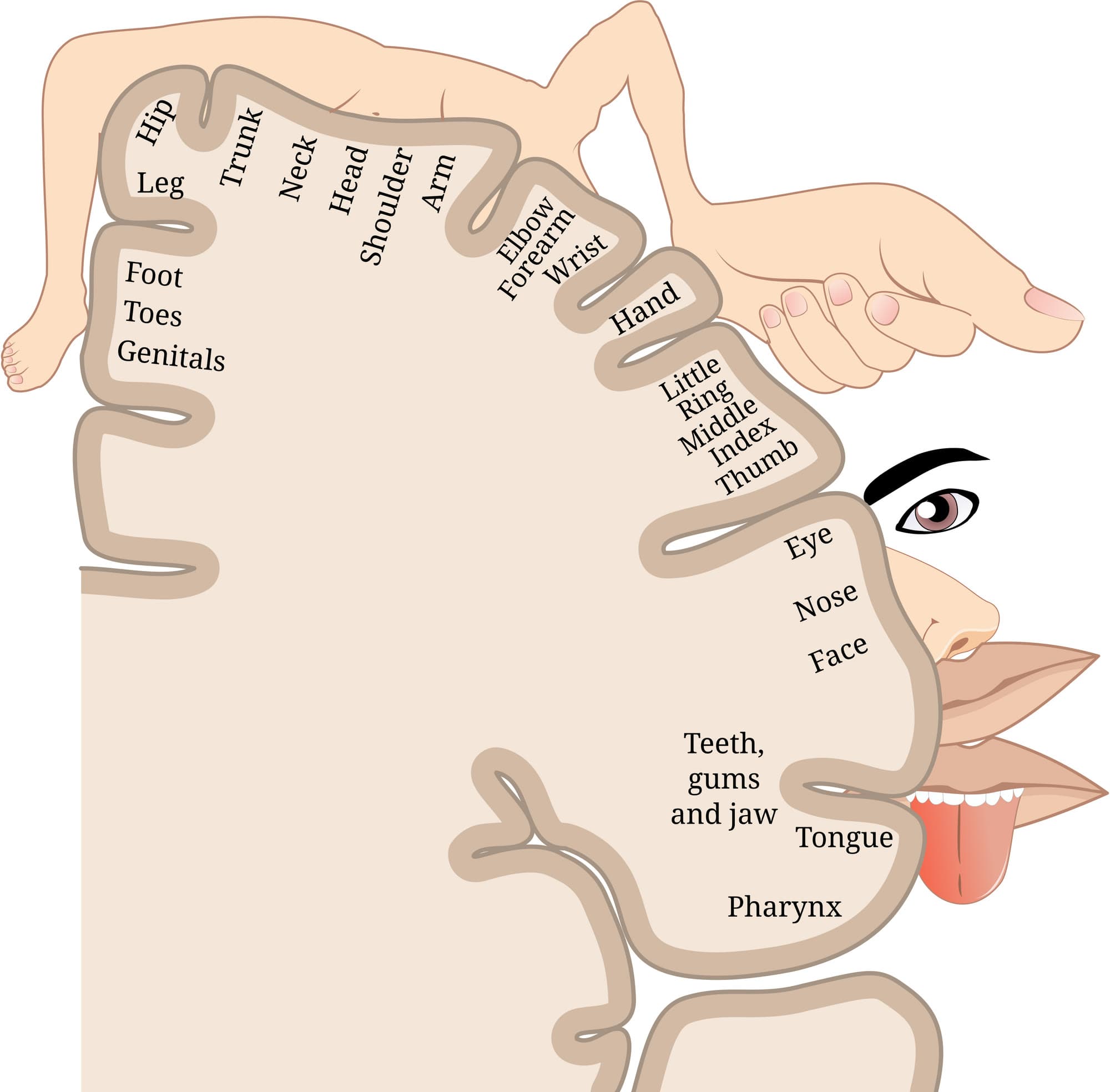
Few parts of you carry as many nerves as your hands. A fingertip has an estimated 241 touch-sensing nerve fibres in every square centimetre, four times as many as your palm. And a big share of the strips of brain that feel and move your body is given over to your hands. The surgeon Wilder Penfield mapped which part of the brain serves which part of the body. Drawn as a little man, that map has huge hands, out of all proportion to the rest of him.
That wiring runs both ways. Your hands feel the world, and they change how tense or steady your whole body is. In a classic test, people stood heel to toe with their eyes closed, and swayed. Then each rested one fingertip on a bar beside them, so lightly it could not hold them up. They steadied as much as when they leaned on the bar. One fingertip, and they swayed far less.
So your hands are not just the end of your arms. They are one of the main controls of your body, as your head is. You can use them in three ways.
02
Loose hands, loose body.
Watch runners late in a long race. Fists clenched, shoulders up by their ears, stride short and stiff. The tension shows in the hands, and it spreads.
On easy work, do the opposite. On an easy run, let your hands go loose, fingers lightly curled, as if you held a crisp you did not want to break. On an easy ride, hold the bars as lightly as the road allows, and let your trunk, not your hands, carry your upper body. That is how you stay comfortable on the bike for hours. Loose hands let your shoulders, neck and jaw relax too.
03
Squeeze when you need tension.
Some work is about holding tension. A heavy goblet squat, with the bell held at your chest. A walk with a heavy bell held straight overhead. A climb on the bike so steep that even your easiest gear is hard work. Here, squeeze hard.
When researchers asked 12 trained men to straighten their knee as hard as they could, they pushed about 15 percent harder when they also gripped hard, clenched their jaw and held their breath. A hard grip spreads tension up your arm and into your shoulder, so the force you make has something firm to push from. Keep the grip, and instead of holding your breath, brace your trunk and keep breathing behind it.
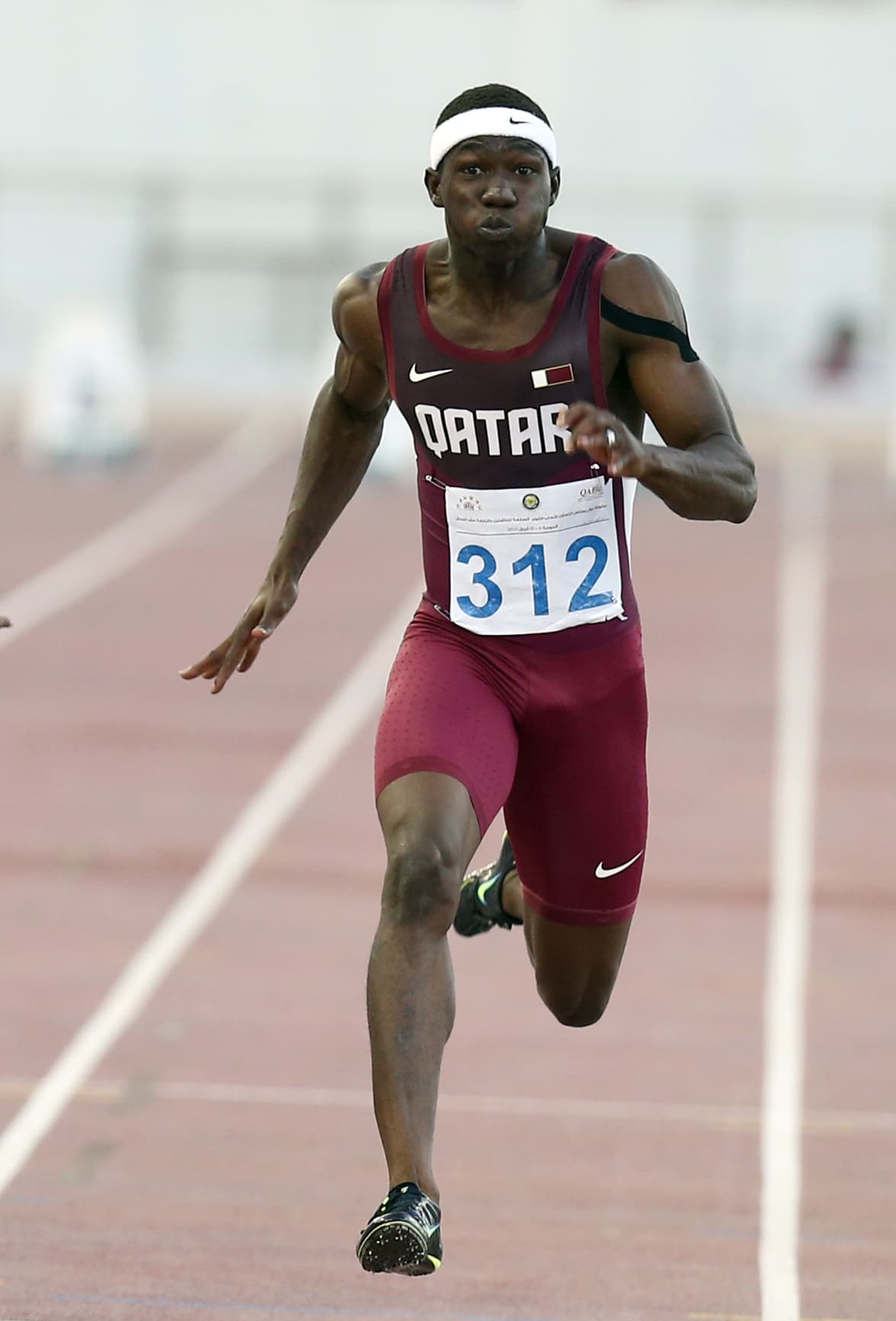
Fast work is different. Watch an elite sprinter. The arms drive hard, but the face is loose and the hands are open, and every stride is as hard as a body can work. Speed needs muscles that switch on and off in a flash, and tension you do not need gets in the way. In a kettlebell swing, your hands are hooks. They hold the handle firmly and never pull; the hips do the work. Squeeze for tension, and stay loose for speed.
04
Your body follows your hands.
Where your hands go also changes where your feet and hips go. As you run, each arm swings forward with the opposite leg and cancels the twist that leg puts through your body. When runners ran with their arms held still, it cost them 3 to 13 percent more energy, and their shoulders and hips twisted to make up for it.
So when a movement feels wrong, start with your hands. If you overstride, landing with your foot far out in front of you, look at your hands. Often they have drifted forward too. Bring them back so they swing past your hips, and your feet tend to come back under you.
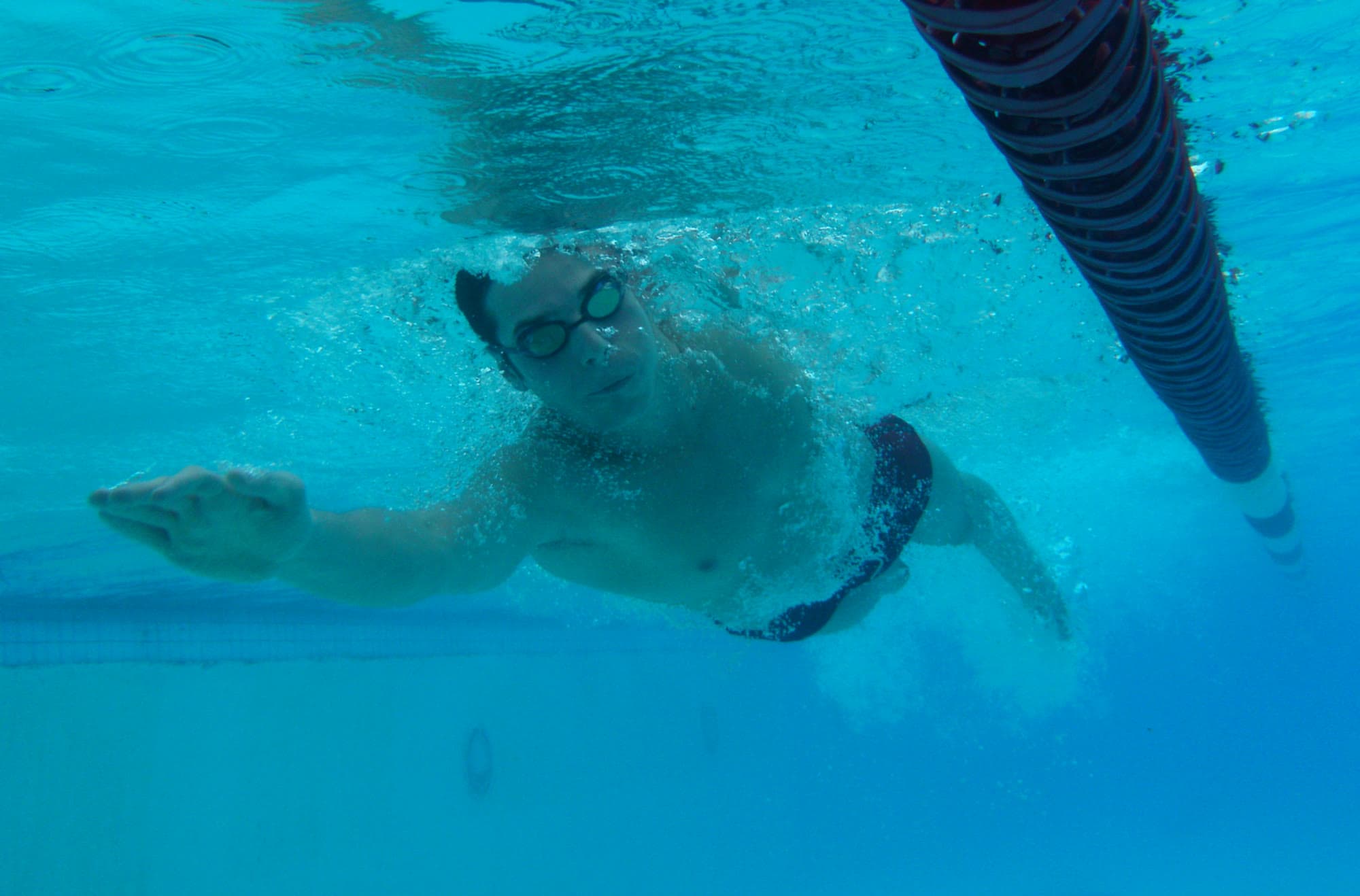
In the water, your hands are how you feel your way forward. As each hand enters and starts to pull, feel for the pressure of the water against your palm and forearm. That pressure is the catch, and the front scull drill teaches you to find it. Good swimmers hunt for it on every stroke. Lose it, and your hand slips through the water without moving you.
Your hand is also the first part of you to arrive. Put it in straight ahead of your own shoulder, not across the middle of your body, and the rest of you follows it in a long, straight line. That gives your stroke its full length.
Like your feet, your hands are one end of a body that moves as one. They are small, but they change how your whole body moves far more than you would think.
Sources (5)
- Johansson and Vallbo 1979. The Journal of Physiology 286:283-300. Tactile sensibility in the human hand, relative and absolute densities of four types of mechanoreceptive units in glabrous skin.
- Catani 2017. Brain 140:3055-3061. A little man of some importance.
- Ebben, Leigh and Geiser 2008. Medicine and Science in Sports and Exercise 40:1805-1809. The effect of remote voluntary contractions on knee extensor torque.
- Arellano and Kram 2014. Journal of Experimental Biology 217:2456-2461. The metabolic cost of human running, is swinging the arms worth it?
- Jeka and Lackner 1994. Experimental Brain Research 100:495-502. Fingertip contact influences human postural control.