Every moment becomes better
You get to the top of the stairs and keep talking. Your bag is heavy, and you carry it through the airport anyway. A friend calls on a Saturday morning and asks if you want to come along, up a hill, out on the water, somewhere you have never been. You say yes without checking whether your body will let you.
None of these moments is training. All of them are what the training is for.
01
Capacity in reserve.
Every ordinary task asks something of the body. The stairs, the shopping, the child who wants to be carried the last kilometre home. For a body with little in reserve, each of these takes a large share of everything it has. That is why they feel hard, and why they get skipped.
Train the body, and the same tasks take a smaller share. The stairs no longer leave you out of breath. The heavy bag is just a bag. The capacity you build in your sessions sits there in reserve, and you spend it all day long without noticing.
02
The ordinary day gets better.
People who move more tend to feel better in their everyday lives. A review of studies of physical activity and quality of life in ordinary adults found the same pattern again and again: the more active people were, the better they rated their health, energy and daily lives. Most of those studies captured one moment, so they show a link rather than proof. But the link held across them.
The earlier chapters showed what sits inside that link. Your mind comes with you: more energy, more confidence and lighter moods. Nature opens up: the hill above the town and the far side of the lake. And a challenge gives every week a direction.
03
Fewer limits as the years go on.
The real test of a capable body comes later, when the years start to add up. In California, researchers followed 538 members of a running club and 423 people who did not run, all aged 50 or over, for 21 years. The runners developed disability later and less of it: the everyday limits that make it hard to walk, dress, climb stairs or get out of a chair. After 19 years, 15 percent of the runners had died, against 34 percent of the others.
Runners who join a club may differ from non-runners in many ways, so this shows what went together, not what caused what. But it is the picture the book has been building towards: a body kept capable stays capable for longer.
04
Fitter people live longer.
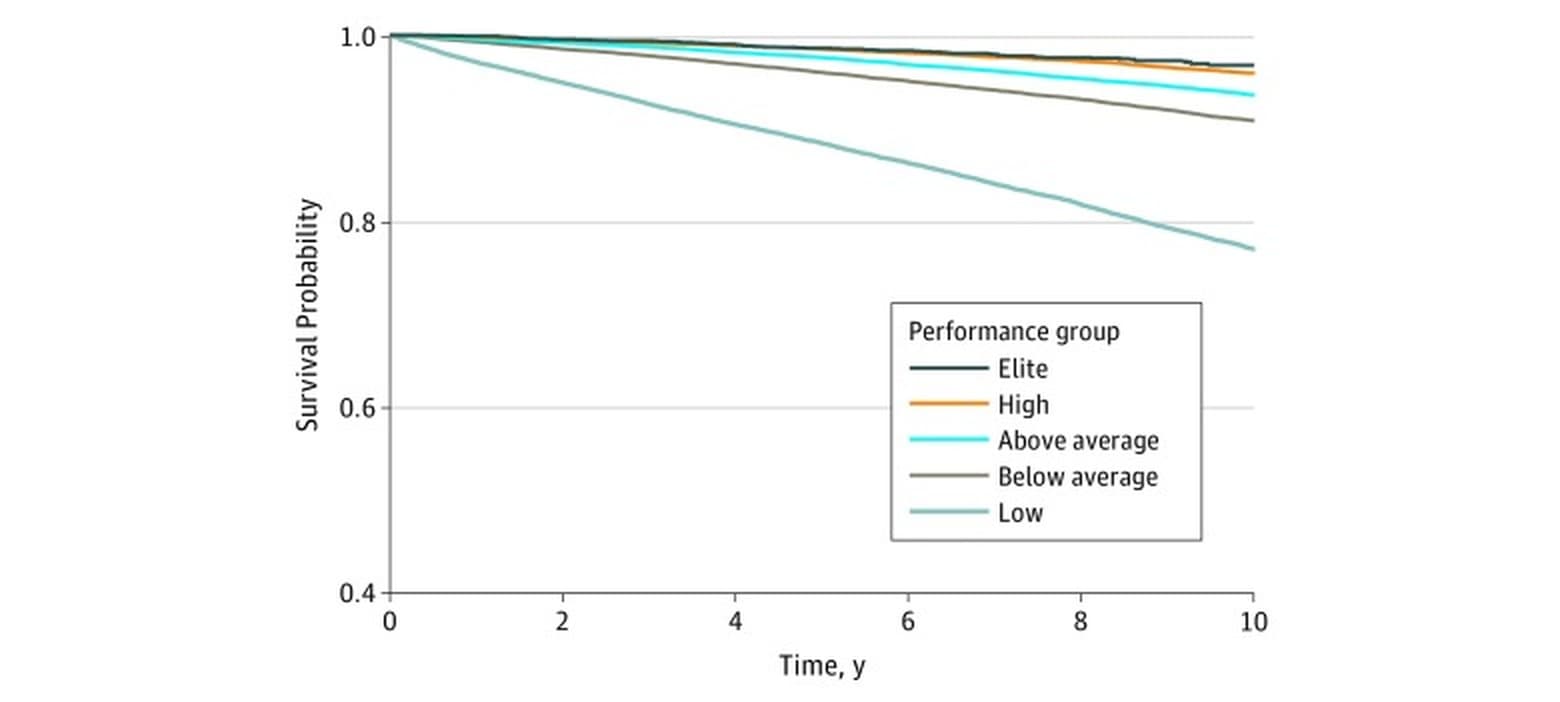
The same holds for the length of life itself. When a clinic in Ohio measured the fitness of 122,007 adults on a treadmill and followed them for a median of eight years, the fitter people were, the less likely they were to die. The least fit were about five times as likely to die as the fittest. And there was no point where more fitness stopped helping: the fittest group of all did best.
These are observations, not guarantees. Training cannot promise anyone a longer life. But the people with the biggest engines lived the longest, and an engine is something you can build.
05
A robust body makes every moment better.
This is what the whole of this first part has been about. The body you were born with was built to go anywhere. Modern life took the movement out of the day, and with it much of what that body could do. You can win it back with mobility, strength and endurance, practised together and pointed at something you want.
What you get is not only a race or a medal. It is a better Tuesday. A stair that is just a stair, a yes instead of a maybe, a day out that ends with you wanting more. And, very likely, more of those days.
The rest of this book shows how. It starts with the body itself.
What this means for you
This week, say yes to one thing you would normally turn down because it looks too hard: the long way round, the hill, the invitation. Notice what your body lets you do.
Embrace endurance sports, so every moment you live is better and your life is longer.
Sources
- Bize, Johnson and Plotnikoff 2007. Preventive Medicine 45:401-415. Physical activity level and health-related quality of life in the general adult population, a systematic review.
- Chakravarty et al. 2008. Archives of Internal Medicine 168:1638-1646. Reduced disability and mortality among aging runners, a 21-year longitudinal study.
- Mandsager et al. 2018. JAMA Network Open 1:e183605. Association of cardiorespiratory fitness with long-term mortality among adults undergoing exercise treadmill testing.